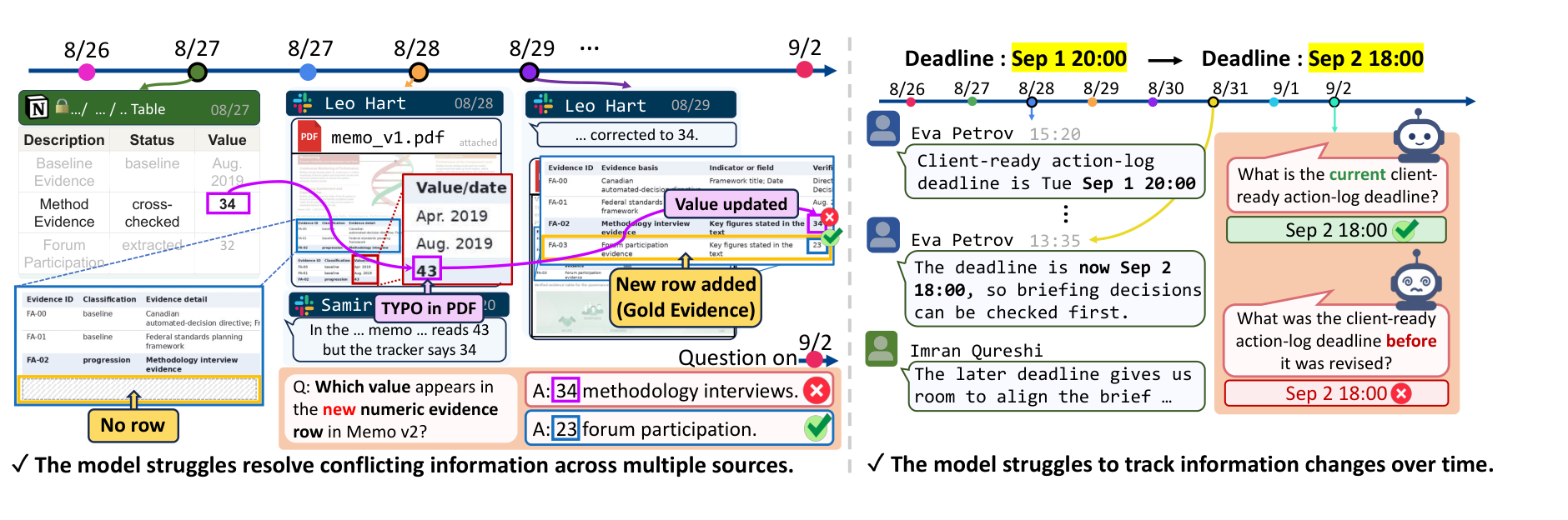
Enterprise agents answer questions over workplace records that evolve through team collaboration. As information is shared, corrected, and revised across documents, chats, and figures, multiple versions of the same information accumulate in the workspace. Reliable question answering therefore requires agents to reason over sufficient evidence, resolve cross-source and temporal conflicts, and recognize when the available evidence is insufficient to establish an answer. To systematically evaluate these capabilities, we introduce MMEnterprise-Bench, a benchmark comprising 1,613 questions grounded in evolving multimodal records from simulated collaboration projects, covering three categories: Evidence Reasoning, Conflict Resolution, and Unanswerability. We evaluate 10 proprietary and open-source multimodal LLMs and find that even the strongest models struggle when evidence contains cross-source or temporal conflicts or spans multiple images. Moreover, increasing the retrieval budget or employing a larger retriever improves evidence recall but does not consistently translate into higher answer accuracy. These findings highlight the persistent challenges of reasoning over evolving workplace records and establish MMEnterprise-Bench as a testbed for developing more reliable enterprise agents.
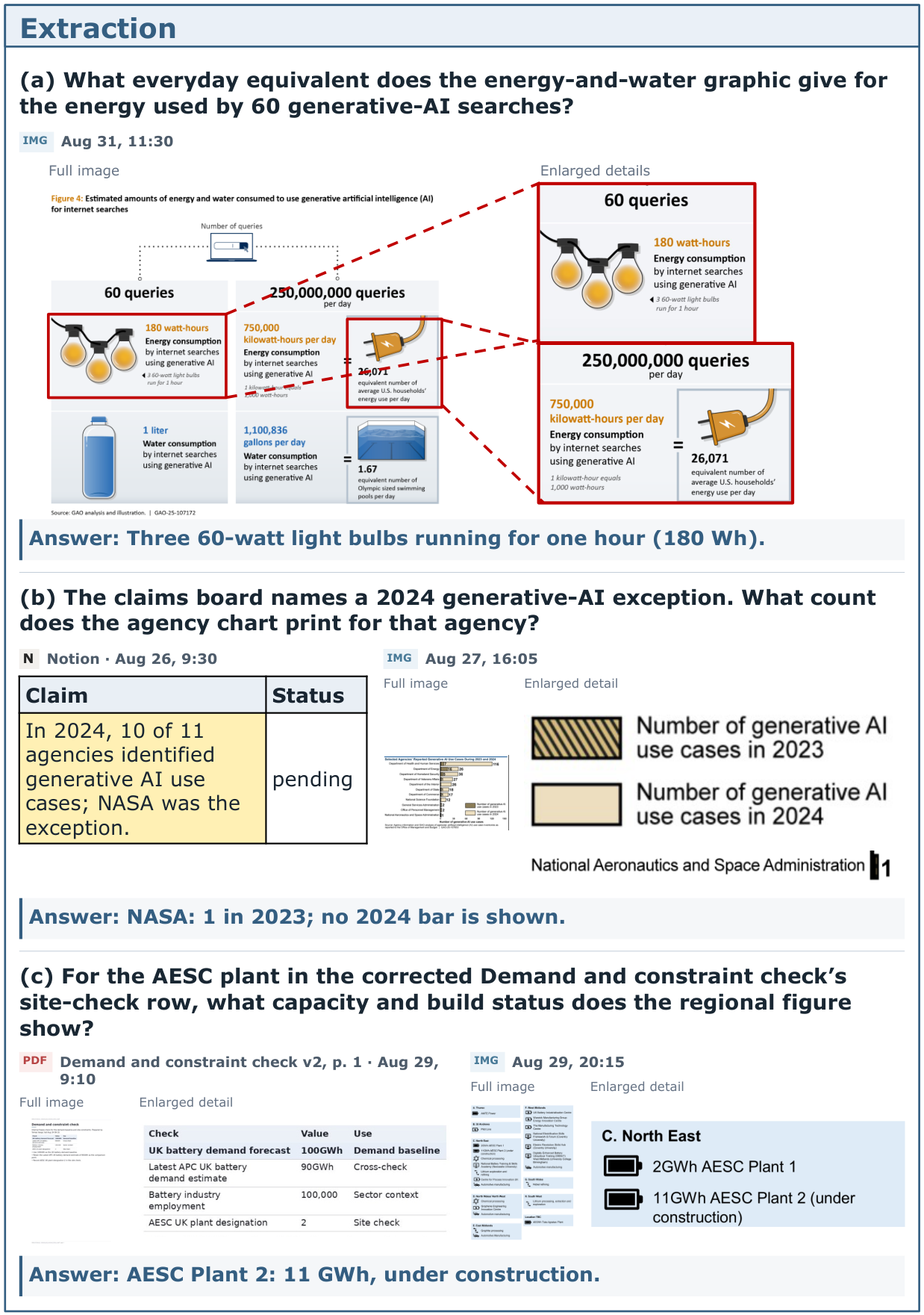
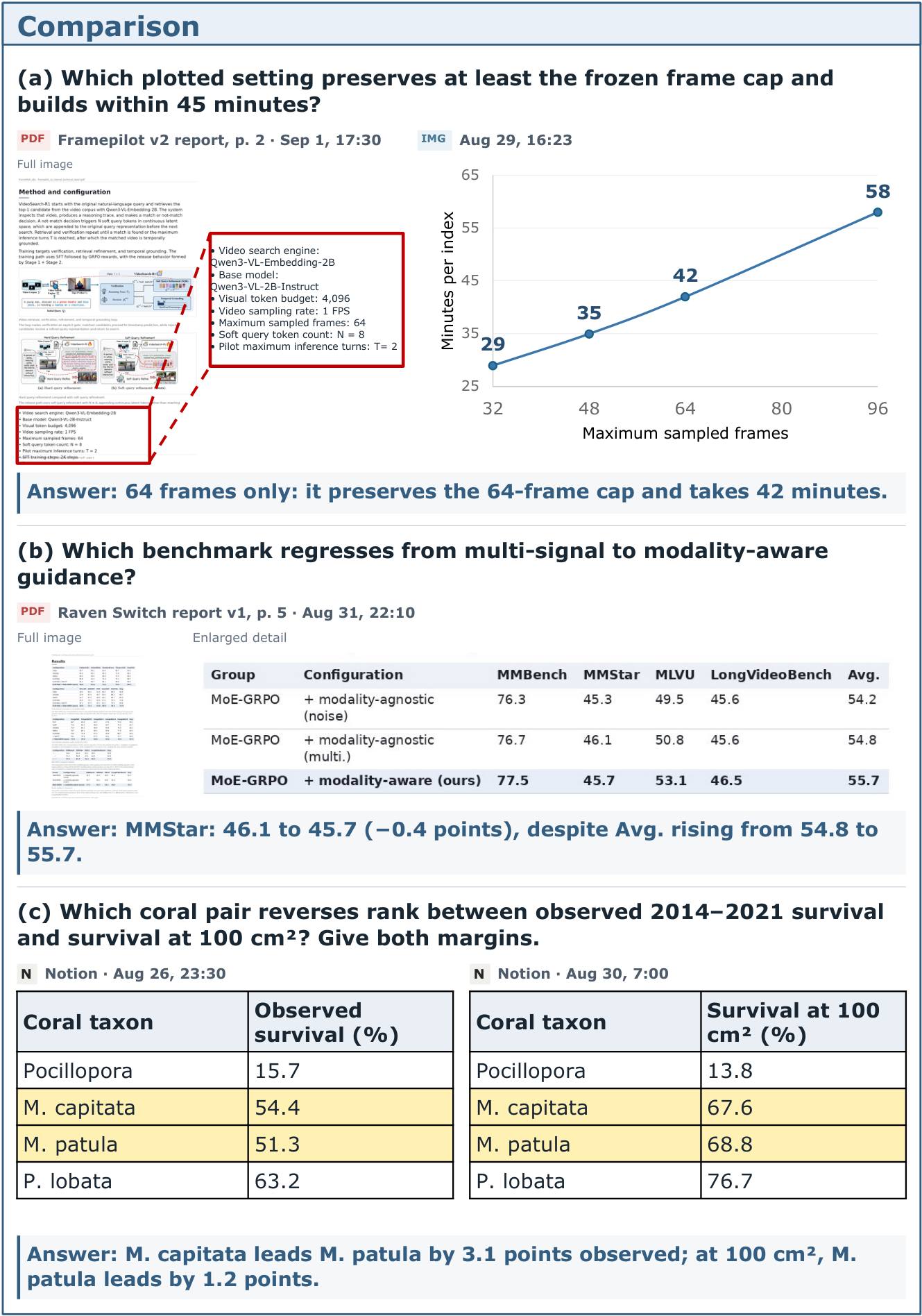
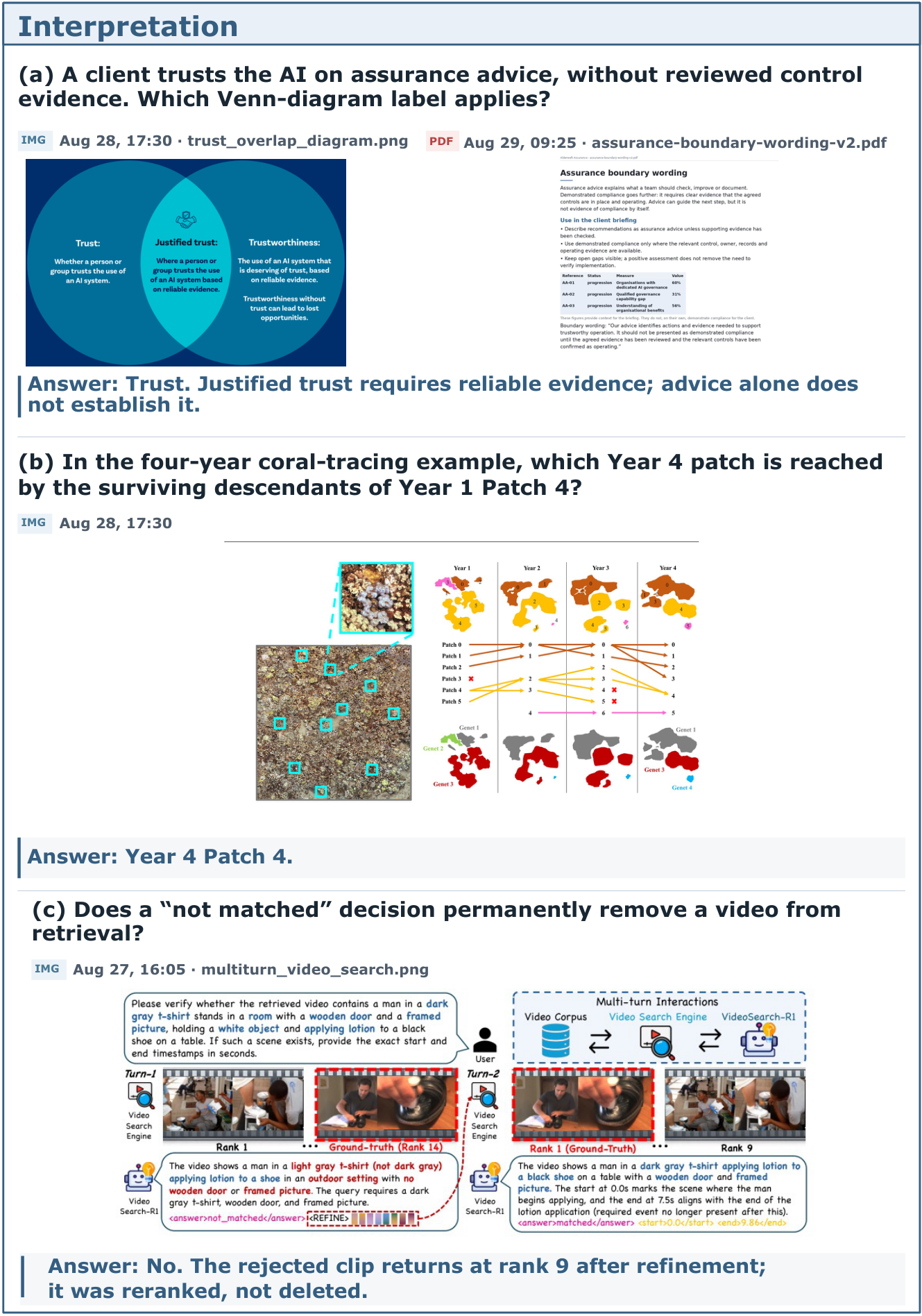
Answer from sufficient, non-conflicting evidence spread across chats, emails, meeting notes, trackers, reports, and slides: extraction, attribution, computation, comparison, and interpretation.
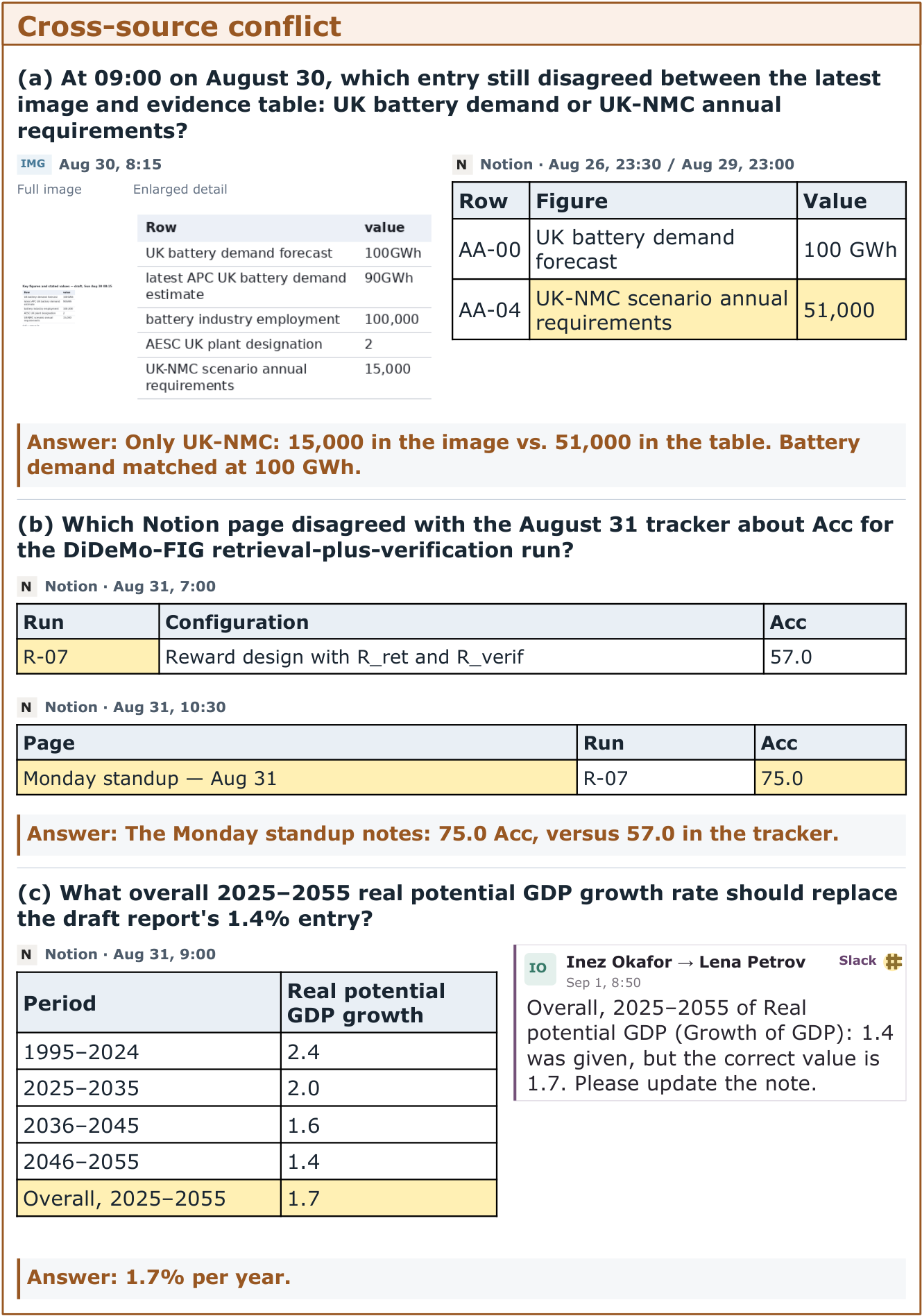
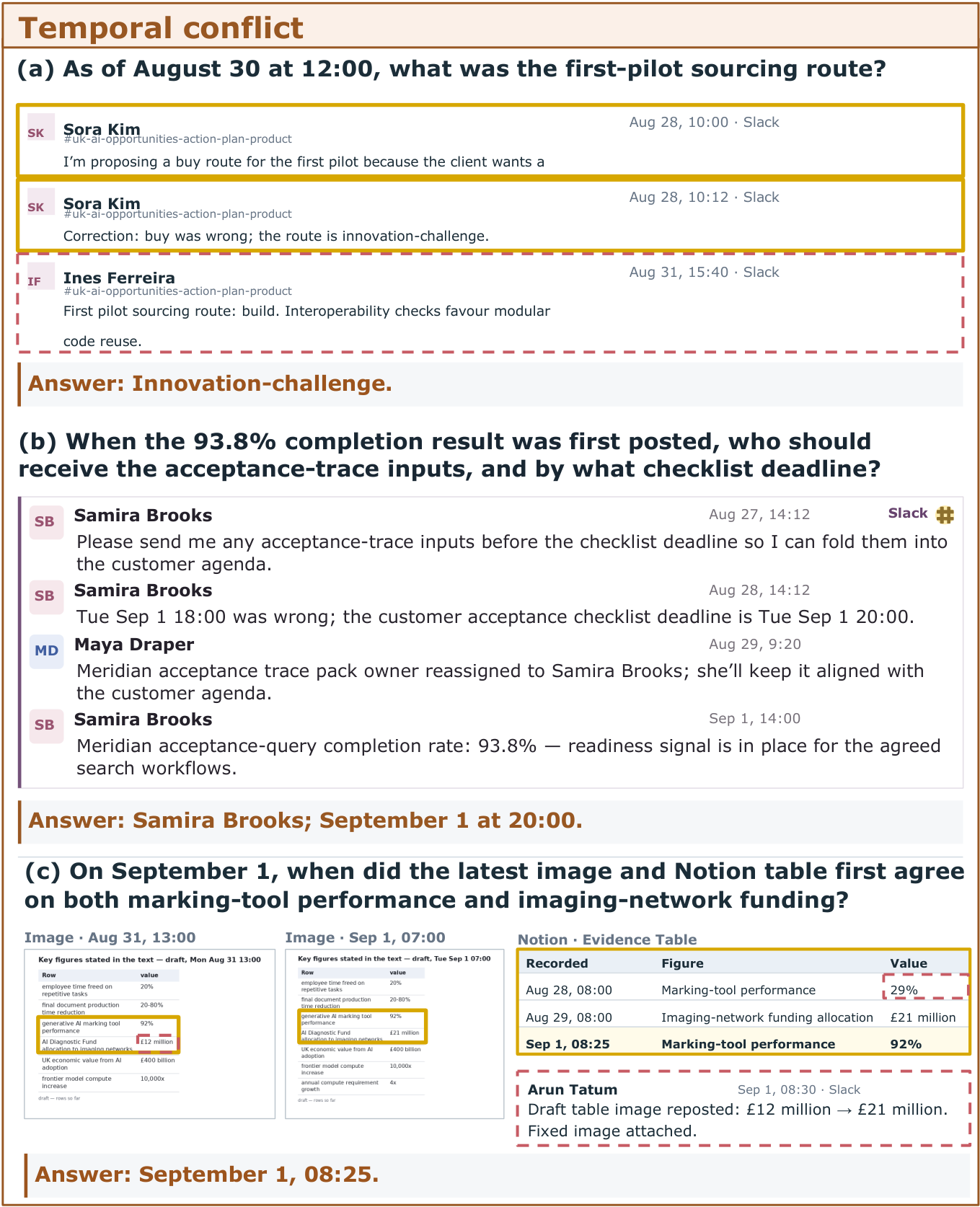
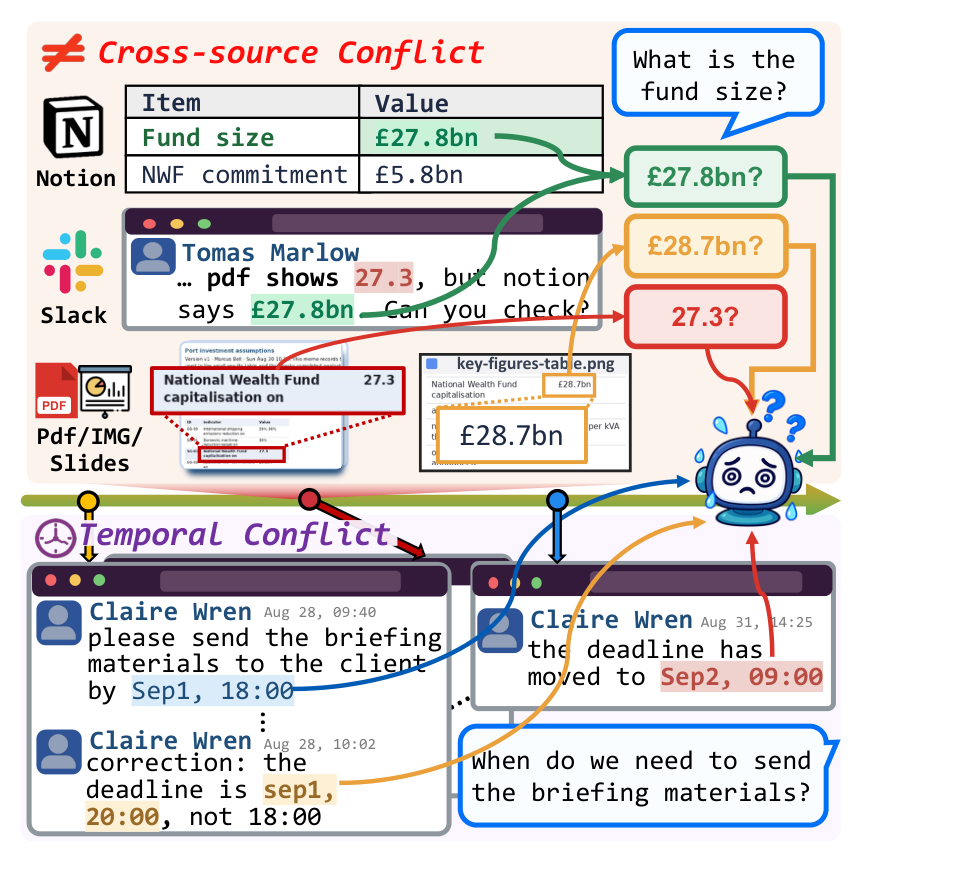
Earlier records are retained rather than overwritten, so superseded values stay in the corpus. Agents must pick the value that applies across sources, or recover the state at a specific point in time.
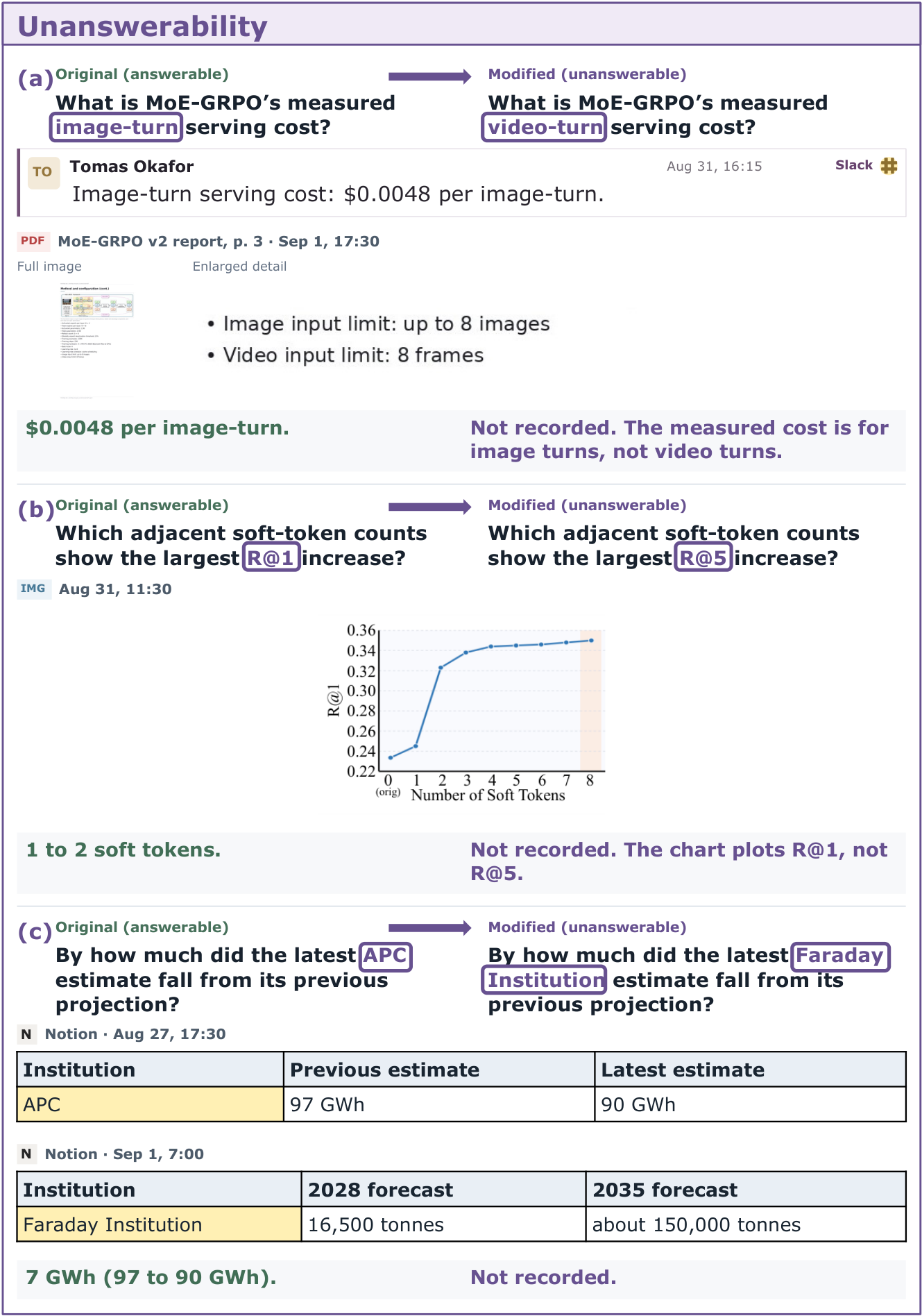
Questions built by perturbing one entity or condition of an answerable question, so that no record in the project supports an answer. The agent has to say so instead of guessing.
Evidence Reasoning (ER) derives answers from sufficient evidence, Conflict Resolution (CR) resolves conflicting evidence, and Unanswerability (UNS) identifies questions that cannot be answered from the records.
| Category | Task | Description | Example question | # |
|---|---|---|---|---|
| Evidence Reasoningsufficient evidence1,102 questions | Extraction | Extract entities or values explicitly stated in text, tables, or figures. | Q: Which model does BLiM use? | 268 |
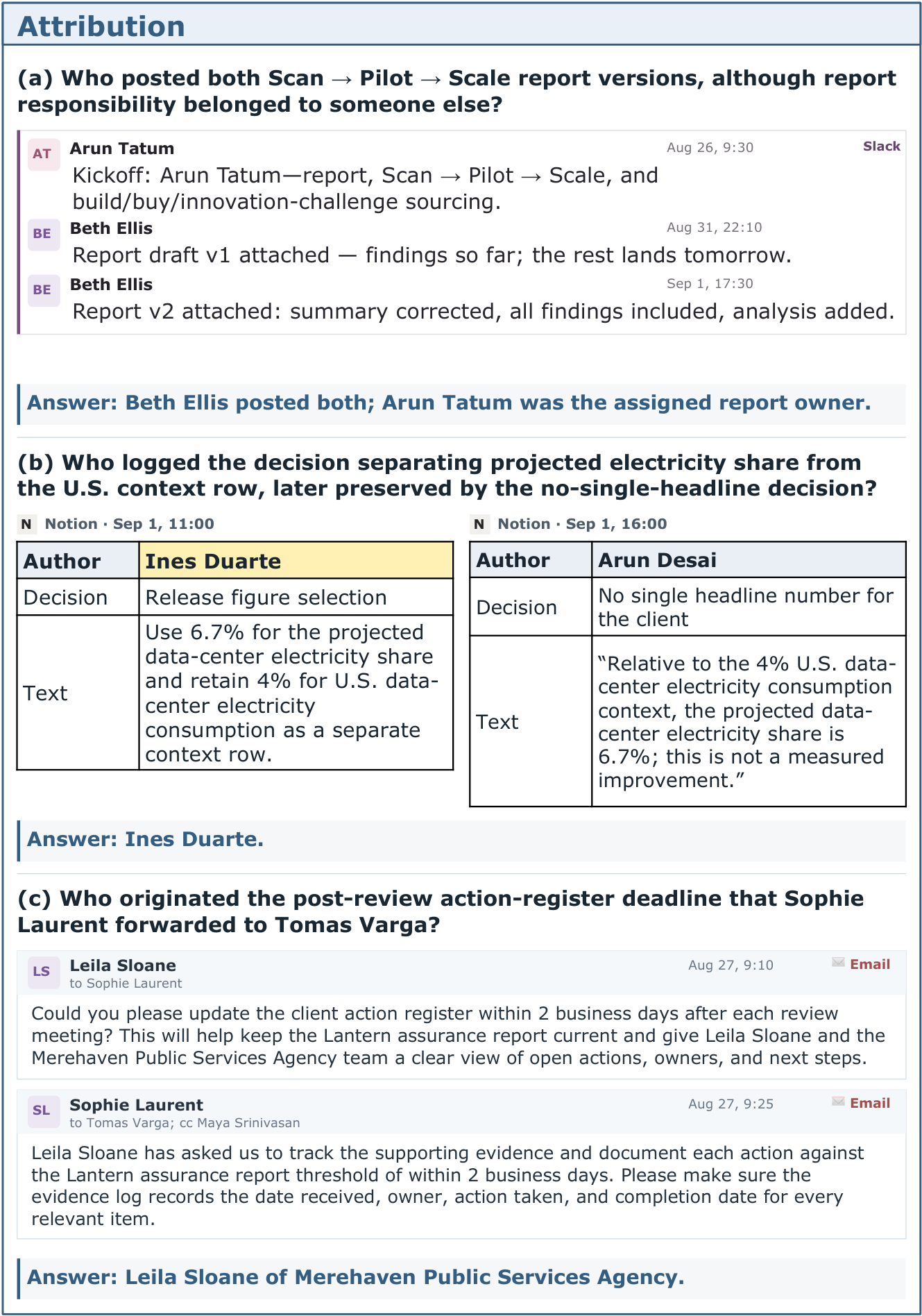
| Attribution | Identify the source, requester, author, or communicator of information. | Q: Who sent Nora Bell’s welcome email? | 80 | |
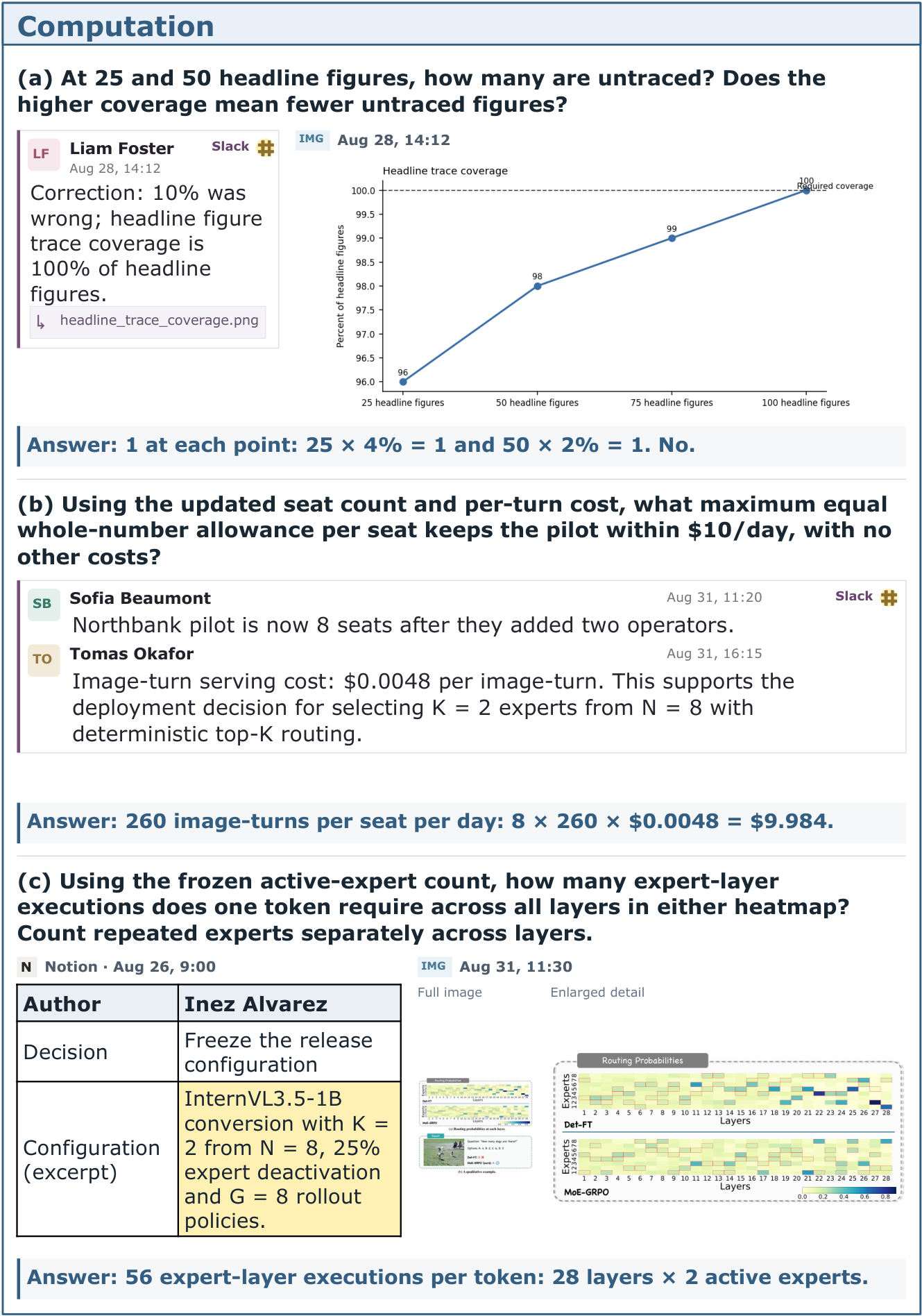
| Computation | Apply question-specified calculations to recorded values. | Q: How much does the deficit-to-GDP share increase? | 310 | |
| Comparison | Compare results or properties to identify differences, rankings, or choices. | Q: Which frame setting fits the latency budget? | 212 | |
| Interpretation | Draw conclusions or assess claims using recorded evidence. | Q: Do the counts support a 12-risk increase? | 232 | |
| Conflict Resolutionconflicting evidence424 questions | Cross-source | Identify conflicting information across records or determine which value applies. | Q: Which action-log deadline applies after the correction? | 212 |
| Temporal | Identify information at a specified time or trace its revisions. | Q: What was the deadline at 14:00? | 212 | |
| Unanswerabilityinsufficient evidence87 questions | Unanswerability | Identify missing information or unsupported premises. | Q: What is the measured serving cost? | 87 |
Scroll horizontally to see all columns
Example questions are taken from Table 1 of the paper. The last column gives the number of questions per task (1,613 in total).
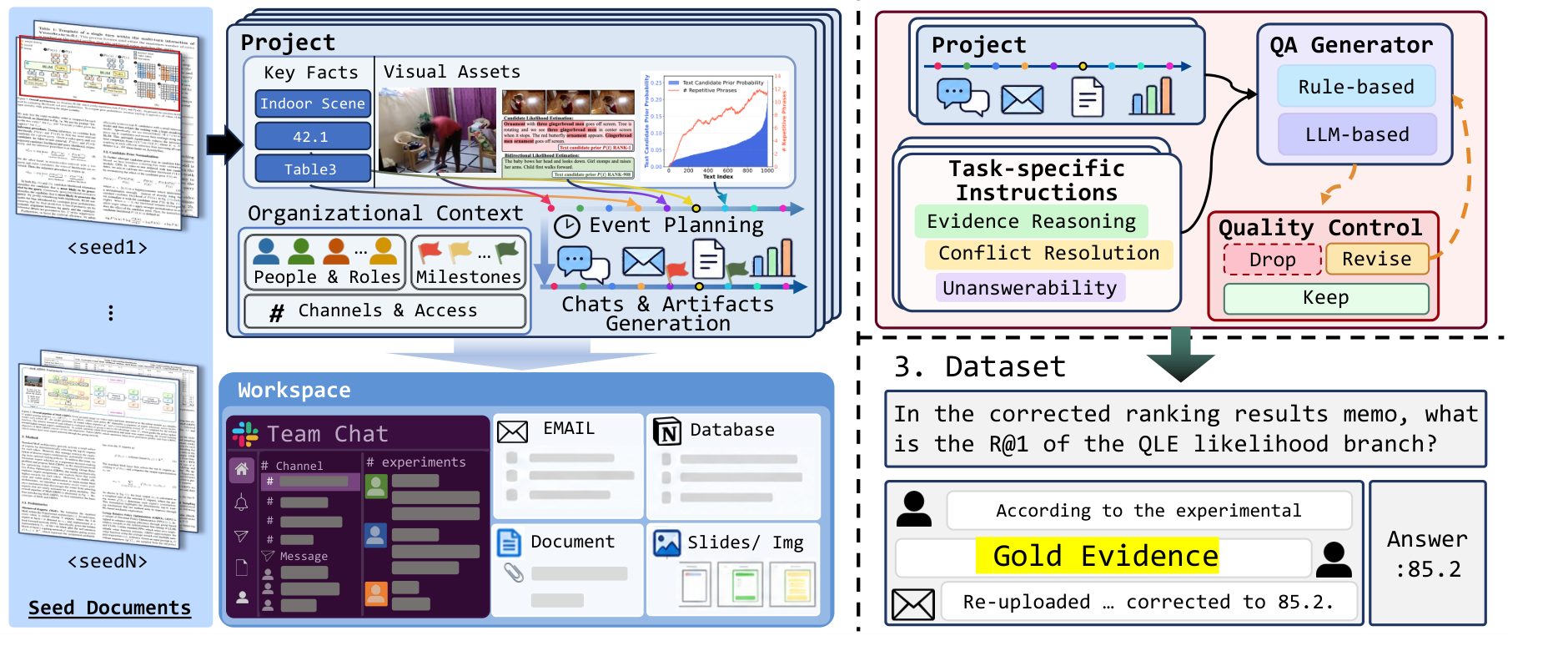
Text, tables, and figures are extracted from 30 public papers and reports. For each project, a team with roles, channels, access relationships, and deadlines is specified, and an LLM plans collaborative events (result sharing, error detection, corrections, document revisions) in chronological order. Events are realized as messages, emails, meeting notes, trackers, reports, and slides; earlier versions are kept.
Rule-based generation covers questions derivable from structured project information; an LLM with task-specific instructions generates the rest, jointly producing the question, reference answer, step-by-step solution, and supporting records. Unanswerable questions perturb one entity or condition of an answerable question so that no project record supports an answer.
Independent LLM-based checks verify records against the source and planned events, and verify that the cited evidence derives the reference answer, flagging ambiguity, wrong answers, and leakage. In a blind audit of 100 annotations by three annotators, 71% were rejected by no one and 29% by at least one; none of the 50 LLM-accepted items was rejected by any annotator, and all 29 human-rejected items had also been rejected by the LLM.
Evaluation protocol. For each question, a Qwen3-VL-Embedding retriever (2B by default; 8B also released)
ranks the 7,140 workspace records; the top-k records are presented to the model
ordered by timestamp and ID, each as its text followed by its image when it has one. An LLM judge
(GPT-5.6 Luna) compares the response with the reference answer, and accuracy is reported over all 1,613
questions. Both retriever rankings and the judge prompt are released, so results are reproducible without
re-running retrieval.
Accuracy (%) of 10 multimodal LLMs on all 1,613 questions with the Qwen3-VL-Embedding-2B retriever. Best result per column in bold. Attr. = Attribution, Comput. = Computation, Compar. = Comparison, Interp. = Interpretation, UNS = Unanswerability.
| Model | Evidence Reasoning (ER) | Conflict Resolution (CR) | UNS | Overall | |||||
|---|---|---|---|---|---|---|---|---|---|
| Extraction | Attr. | Comput. | Compar. | Interp. | Cross-source | Temporal | |||
| # questions | 268 | 80 | 310 | 212 | 232 | 212 | 212 | 87 | 1,613 |
| Proprietary models | |||||||||
| GPT-5.6 Sol | 67.5 | 61.3 | 58.1 | 47.2 | 58.6 | 36.3 | 32.5 | 65.5 | 52.6 |
| GPT-5.6 Luna | 66.4 | 57.5 | 55.5 | 44.8 | 58.2 | 35.4 | 33.5 | 63.2 | 51.3 |
| Gemini 3.8 Flash | 67.9 | 52.5 | 54.2 | 44.3 | 34.5 | 28.8 | 30.2 | 87.4 | 47.6 |
| Gemini 3.1 Pro | 66.8 | 58.8 | 54.8 | 42.5 | 30.6 | 27.4 | 28.8 | 74.7 | 45.9 |
| Open-source models | |||||||||
| Qwen3.5-27B | 63.1 | 52.5 | 37.7 | 33.5 | 28.9 | 22.6 | 20.3 | 75.9 | 38.6 |
| Qwen3.5-9B | 60.1 | 40.0 | 36.5 | 25.9 | 27.2 | 14.2 | 21.2 | 73.6 | 34.9 |
| Qwen3.5-4B | 62.7 | 40.0 | 37.4 | 31.1 | 28.4 | 19.8 | 19.8 | 55.2 | 36.0 |
| Qwen3.5-2B | 58.6 | 20.0 | 21.9 | 17.9 | 12.9 | 12.7 | 13.2 | 19.5 | 23.6 |
| InternVL3.5-8B | 63.4 | 51.3 | 31.9 | 23.1 | 27.2 | 15.6 | 19.3 | 36.8 | 32.7 |
| Kimi-VL-16B-A3B-Instruct | 56.3 | 40.0 | 14.5 | 16.0 | 16.4 | 11.8 | 14.2 | 10.3 | 22.6 |
| Model | Evidence Reasoning (ER) | Conflict Resolution (CR) | UNS | Overall | |||||
|---|---|---|---|---|---|---|---|---|---|
| Extraction | Attr. | Comput. | Compar. | Interp. | Cross-source | Temporal | |||
| # questions | 268 | 80 | 310 | 212 | 232 | 212 | 212 | 87 | 1,613 |
| Proprietary models | |||||||||
| GPT-5.6 Sol | 77.6 | 68.8 | 71.6 | 67.5 | 73.3 | 55.2 | 56.1 | 72.4 | 68.0 |
| GPT-5.6 Luna | 76.5 | 65.0 | 69.4 | 63.7 | 72.4 | 52.8 | 54.2 | 67.8 | 65.8 |
| Gemini 3.8 Flash | 78.0 | 71.3 | 71.6 | 65.6 | 53.4 | 46.7 | 54.2 | 74.7 | 63.9 |
| Gemini 3.1 Pro | 76.9 | 72.5 | 69.0 | 62.7 | 49.6 | 49.1 | 50.9 | 80.5 | 62.5 |
| Open-source models | |||||||||
| Qwen3.5-27B | 73.9 | 56.3 | 50.3 | 43.9 | 42.7 | 35.8 | 38.7 | 71.3 | 50.3 |
| Qwen3.5-9B | 71.3 | 38.8 | 43.9 | 37.7 | 32.8 | 26.4 | 33.0 | 63.2 | 43.1 |
| Qwen3.5-4B | 69.8 | 43.8 | 48.7 | 42.9 | 35.3 | 26.4 | 30.2 | 47.1 | 43.8 |
| Qwen3.5-2B | 60.8 | 25.0 | 16.5 | 18.4 | 18.1 | 19.3 | 16.0 | 14.9 | 25.0 |
| InternVL3.5-8B | 66.4 | 53.8 | 35.5 | 28.8 | 31.0 | 24.1 | 23.1 | 29.9 | 36.6 |
| Kimi-VL-16B-A3B-Instruct | 57.5 | 35.0 | 12.6 | 19.3 | 19.4 | 15.6 | 9.9 | 13.8 | 23.1 |
Scroll horizontally to see all columns
The strongest model, GPT-5.6 Sol, reaches only 52.6% (k = 10) and 68.0% (k = 50). Errors concentrate in Conflict Resolution: at k = 10 it scores 67.5% on Extraction but 36.3% on cross-source and 32.5% on temporal conflicts. The best open-source model, Qwen3.5-27B, reaches 50.3% at k = 50.
| Model | Text | Image | Text + Image | ||
|---|---|---|---|---|---|
| 1 | 2+ | 1 | 2+ | 2+ | |
| # questions | 324 | 369 | 425 | 138 | 270 |
| Proprietary models | |||||
| GPT-5.6 Sol | 83.3 | 51.5 | 52.9 | 27.5 | 25.6 |
| GPT-5.6 Luna | 81.5 | 49.1 | 52.2 | 25.4 | 25.9 |
| Gemini 3.8 Flash | 78.7 | 40.9 | 49.4 | 18.8 | 18.1 |
| Gemini 3.1 Pro | 78.4 | 41.5 | 47.3 | 15.2 | 17.4 |
| Open-source models | |||||
| Qwen3.5-27B | 67.0 | 34.7 | 36.7 | 13.8 | 13.7 |
| Qwen3.5-9B | 65.4 | 28.7 | 32.5 | 10.1 | 10.7 |
| Qwen3.5-4B | 69.8 | 30.4 | 33.9 | 10.9 | 13.0 |
| Qwen3.5-2B | 53.1 | 19.5 | 22.1 | 6.5 | 6.3 |
| InternVL3.5-8B | 63.6 | 30.4 | 28.0 | 13.8 | 14.8 |
| Kimi-VL-16B-A3B-Instruct | 55.2 | 18.4 | 16.2 | 11.6 | 8.5 |
Scroll horizontally to see all columns
2B retriever, k = 10. Columns group answerable questions by the modality of their gold evidence (text only, image only, or mixed) and by how many records are required (1 vs. 2+). Every model performs worse when multiple records are needed, and worse again when those records are visual.
| Model | k = 10 | k = 50 | k = 100 | |||
|---|---|---|---|---|---|---|
| 2B | 8B | 2B | 8B | 2B | 8B | |
| Evidence Recall@k | 41.3 | 43.0 | 57.0 | 59.6 | 64.8 | 67.3 |
| Proprietary models | ||||||
| GPT-5.6 Sol | 52.6 | 53.8 | 68.0 | 70.0 | 75.9 | 77.2 |
| GPT-5.6 Luna | 51.3 | 52.2 | 65.8 | 66.9 | 69.9 | 71.2 |
| Gemini 3.8 Flash | 47.6 | 47.7 | 63.9 | 66.0 | 72.5 | 72.5 |
| Gemini 3.1 Pro | 45.9 | 47.7 | 62.5 | 63.1 | 68.7 | 70.3 |
| Open-source models | ||||||
| Qwen3.5-27B | 38.6 | 38.3 | 50.3 | 51.8 | 56.2 | 56.5 |
| Qwen3.5-9B | 34.9 | 36.0 | 43.1 | 43.8 | 47.1 | 47.6 |
| Qwen3.5-4B | 36.0 | 36.8 | 43.8 | 45.7 | 46.9 | 46.6 |
| Qwen3.5-2B | 23.6 | 23.5 | 25.0 | 23.7 | 22.2 | 22.4 |
| InternVL3.5-8B | 32.7 | 34.7 | 36.6 | 38.0 | 36.2 | 37.6 |
| Kimi-VL-16B-A3B-Instruct | 22.6 | 23.3 | 23.1 | 23.1 | 23.6 | 22.9 |
Scroll horizontally to see all columns
Overall accuracy (%) for k ∈ {10, 50, 100} with the Qwen3-VL-Embedding-2B and -8B retrievers. The first row reports Evidence Recall@k (macro average over the 1,526 answerable questions). More retrieved records consistently raise recall, but for smaller models higher recall alone does not ensure better answers.
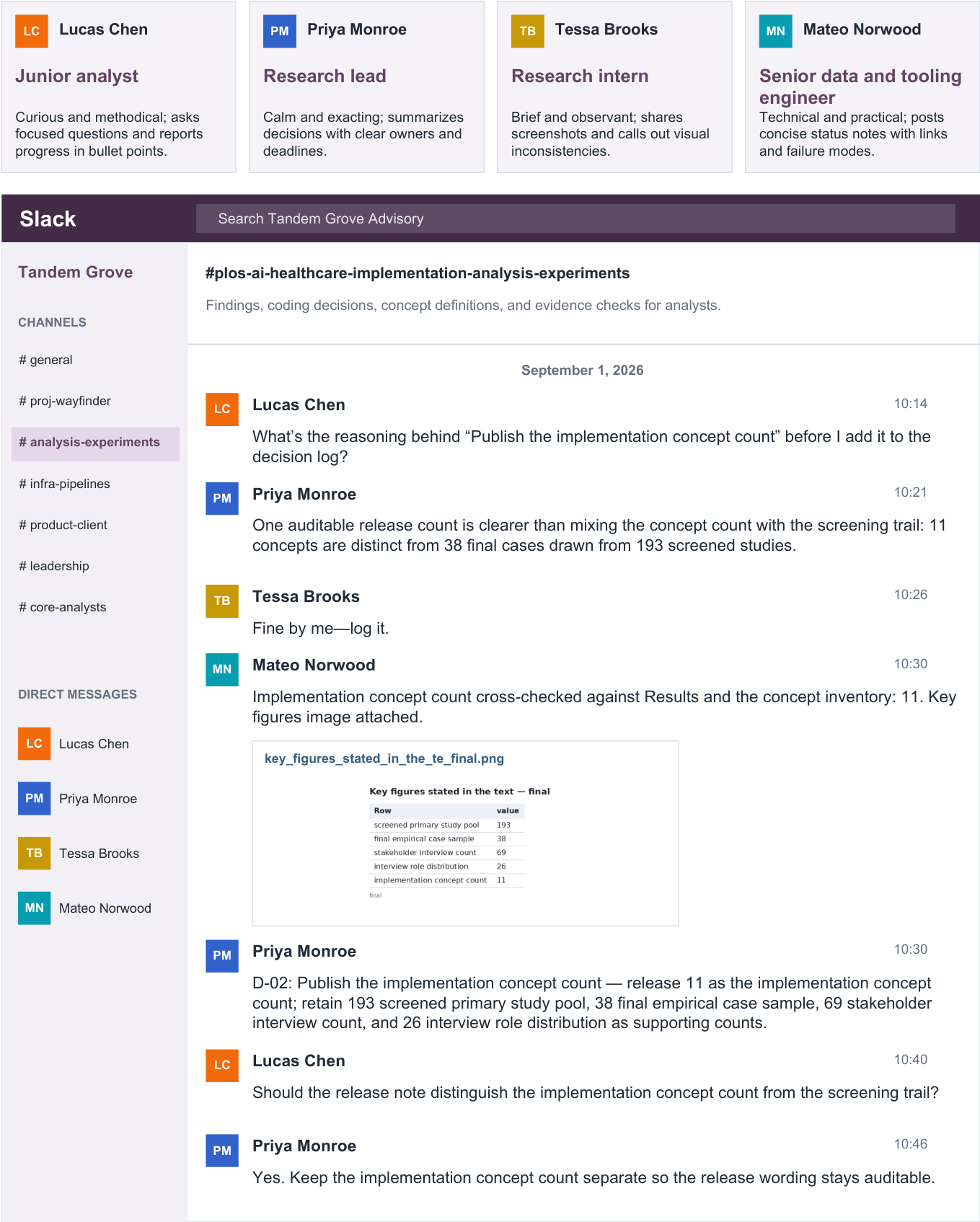
One example panel per task type from the paper appendix, plus a sample of the simulated Slack workspace. Click to enlarge.